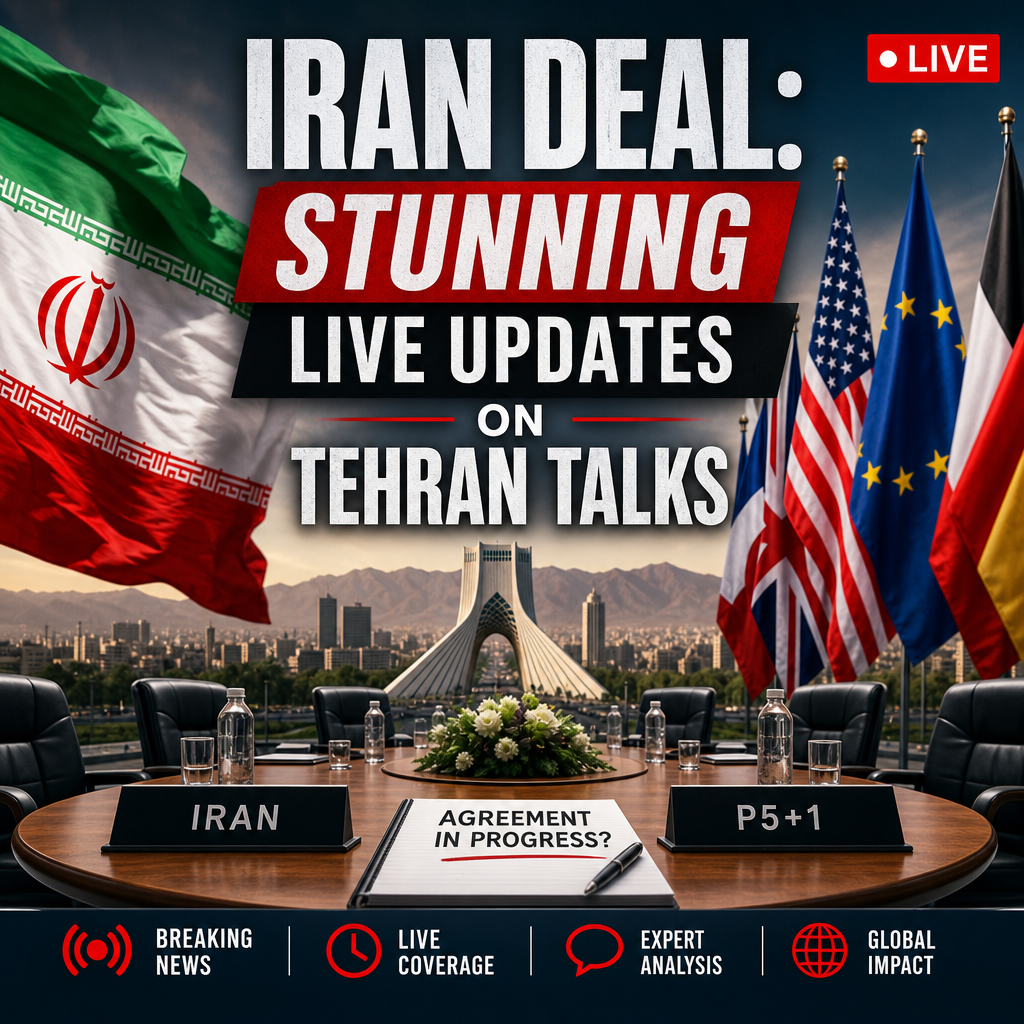
Iran Deal: Stunning Live Updates on Tehran Talks


Iran Deal discussions are once again exposing the deep gap between diplomacy’s promises and the political realities that surround Tehran’s negotiations. Across international coverage, the core story is not simply whether a breakthrough is possible, but what kind of agreement each side would actually accept, and how much trust remains after years of confrontation, sanctions, and stop-start diplomacy.
What stands out in the latest reporting is that the talks are being interpreted very differently depending on the lens used. Some outlets emphasize the pressure campaign on Iran and the risk of escalation if negotiations fail. Others focus on Tehran’s leverage, arguing that Iran has become too strategically important to be treated as a passive participant. A third thread, more visible in regional coverage, asks a practical question: even if there is movement at the table, can any deal survive the wider crises around it?



Why the Iran Deal still matters
The Iran nuclear file remains one of the most consequential diplomatic disputes in the world because it sits at the intersection of security, energy, sanctions, and regional politics. For Western governments, the main concern is preventing Iran from expanding nuclear capabilities in a way that shortens the time needed to reach weapons-grade material. For Tehran, the issue is just as much about sovereignty and economic survival as it is about technology.
That tension helps explain why negotiations repeatedly stall. Iran has long argued that it is being asked to give up bargaining chips without receiving enough economic relief in return. Western governments, meanwhile, have been reluctant to provide major sanctions relief without firmer verification and limits. In practical terms, each side wants the other to move first.




Sky News-style coverage tends to underline the security side of the equation: any deal is judged by whether it truly reduces nuclear risk and calms a region already under strain. That perspective often reflects concern from the United States, European governments, and Israel, where officials remain wary of a deal that could be seen as too soft or too easily reversible.
By contrast, reporting in outlets like Al Jazeera more often places the negotiations inside a broader regional and political frame. From that angle, the talks are not just about centrifuges and uranium stockpiles. They are about whether Iran can secure economic breathing room, whether Washington is prepared to make credible commitments, and whether diplomacy can function in a climate shaped by wars, sanctions, and mutual suspicion.
RT’s coverage, unsurprisingly, tends to stress the asymmetry of pressure and the argument that Iran is being forced into talks under hostile conditions. That approach highlights how Tehran sees itself: not as the sole source of instability, but as a state responding to decades of coercion and shifting Western demands.
Iran Deal talks: competing narratives, same hard choices
Even when the headlines suggest progress, the underlying positions remain difficult to reconcile. Broadly speaking, the main issues appear to fall into four buckets:
– Nuclear limits: How far Iran would reduce or cap enrichment and how intrusive inspections would be.
– Sanctions relief: Whether the lifting of economic restrictions would be immediate, phased, or partial.
– Guarantees: Whether Iran can trust that a future U.S. administration would not abandon the deal again.
– Regional spillover: How wider tensions in Gaza, Lebanon, Syria, and the Gulf affect the diplomatic environment.
The challenge is that each of these issues is tied to a different kind of mistrust. Iran doubts the durability of U.S. promises. The West doubts Iranian compliance and intent. Regional states fear being left vulnerable if a deal is struck without addressing broader security concerns.
That is why the story is rarely about a single dramatic breakthrough. More often, it is about incremental movement, rhetorical signaling, and whether enough common ground exists to prevent collapse. Even when officials sound optimistic, they are often testing the ground rather than announcing a final landing point.
What the latest coverage suggests
The most responsible takeaway from the available reporting is that there is movement, but not certainty. There is enough diplomatic activity to keep hopes alive, yet enough disagreement to make any quick resolution unlikely. That is a familiar pattern in Iran diplomacy: both sides continue talking because the alternative is worse, but neither side appears ready to accept the full cost of compromise.
Several themes appear consistent across different coverage styles:
1. Negotiators are still trying to keep the process alive.
The very fact that the talks remain active suggests that neither side wants a total breakdown.
2. There is no clear shared narrative.
One camp describes Iran as needing to prove peaceful intent; another says the West must first show good faith.
3. Regional instability complicates everything.
Any agreement on the nuclear issue now lands in a much more volatile Middle East than during earlier rounds of diplomacy.
4. Public messaging is strategic.
Officials on all sides often speak to domestic audiences as much as to one another, which makes reading the talks especially difficult.
That uncertainty matters. It means readers should be cautious about assuming that optimistic language equals a deal, or that tension equals failure. The negotiations may be real without being ready.
The bigger picture beyond the headlines
The deeper issue is whether a new Iran deal can be more durable than previous attempts. That is the central question hanging over every update. A short-term agreement might lower immediate risk, but unless it addresses verification, sanctions relief, and political trust, it could simply postpone the next crisis.
A more durable deal would require each side to accept something uncomfortable:
– Iran would need to accept stronger limits and monitoring.
– The United States and its partners would need to offer sanctions relief with enough credibility to matter.
– Regional powers would need reassurance that diplomacy is not being used to ignore their security concerns.
That is a tall order. But it is also why the talks continue. For all the frustration, neither confrontation nor stalemate offers a clean solution.
For now, the most balanced reading is this: the Iran Deal process remains alive, but fragile. The latest updates suggest a negotiation that is serious, contested, and still far from resolution. In that sense, the real story is not a sudden diplomatic victory or collapse. It is the uneasy persistence of a problem that no side can fully solve on its own.